By Maria Jampolsky, RDMS, Managing Director of HI Frequency Imaging and Sonio user
Despite its high resources, maternal mortality in the United States is the highest among high‑income countries.
Access Challenges
Many high-income countries report maternal mortality rates below 10 per 100,000 deliveries, while in 2022 the United States reported approximately 22 maternal deaths per 100,000 deliveries.
In Hawaii, geographic isolation and variations in access to specialty care can create additional challenges for some expectant families, particularly in rural and medically underserved communities. According to the University of Hawaii Rural Health Research and Policy Center, 33.3% of pregnant Native Hawaiian women living in high-vulnerability areas received inadequate prenatal care. This figure increased to 64.3% among Pacific Islander populations in similar communities.
These findings highlight the importance of improving timely access to prenatal services, specialty consultation, and diagnostic imaging across Hawaii’s islands.
Drivers of Disparities
Most maternal deaths occur after delivery, and up to 80% of them are thought to be preventable. While many reasons have been proposed for this significant statistical disparity between the United States and other high‑income countries, one of the most prominent ones is the lack of access and unequal provision of maternal care.
According to a 2024 report by March of Dimes, over 35% of U.S. counties are classified as maternity care deserts, affecting more than 2.3 million women of reproductive age.
The term ‘maternity healthcare desert’ refers to “any county without a hospital or birth center offering obstetric care and without obstetric providers.” In Hawaii, access is often better captured by travel time: over 23% of patients reside in an area more than 30 minutes from a birthing hospital, according to the University of Hawaii Rural Health Research Policy Center.
Half of U.S. counties lack a hospital that provides obstetric care, and more than a third don’t have a single obstetric clinician, according to a new report that portrays workforce shortages and hospital closures as an everyday reality.
The Impact on Complex Pregnancies
Prenatal care is essential for monitoring the health of both the mother and the developing fetus throughout pregnancy. Total lack of, inadequate, or delayed prenatal care increases the risk of complications such as hypertensive disorders of pregnancy, fetal growth restriction, and detection and management of congenital anomalies.
In many of Hawaii’s neighbor island communities, access to the full spectrum of obstetrical ultrasound screenings with perinatologist interpretation is limited, which can delay the identification of high-risk pregnancies and impact timely care planning.
Island areas are often found to be medically underserved, especially for expectant mothers receiving care. States, such as Hawaii, have had to overcome geographical barriers to ensure the ability of medical care for pregnant patients. One of the most critical components to a healthy pregnancy is to integrate proactive and early-stage prenatal care (PNC) practices, and according to March of Dimes, nearly 7.5% more women in Hawaii received inadequate PNC at 22.2%, compared to 14.8% nationally.
Pregnancies involving multiple gestations (twins or more), which carry increased risks of premature birth and low birth weight, are also less likely to be properly managed. Additionally, maternal pre-existing conditions like Type 1 diabetes, heart disease, or autoimmune disorders, each necessitating close monitoring, often receive insufficient attention due to geographic and systemic barriers to care.
Limited access to subspecialty support can make timely diagnosis and ongoing surveillance more difficult. These barriers can contribute to delays in care coordination and management of high-risk pregnancies, including increased maternal and infant morbidity and mortality.
The Tools Changing Care for Rural Mothers: TeleMFM
In response to the lack of access to specialists for high‑risk obstetrical patients, technology is emerging as a powerful equalizer. Since 2020, there has been a significant acceleration in the adoption of virtual care as a legitimate and necessary alternative. This shift is vital in rural and underserved areas, where healthcare facilities are scarce and transportation barriers make timely access to care more difficult.
TeleMFM is especially relevant for:
- Neighbor‑island patients who would otherwise need to travel to O‘ahu for detailed fetal anatomy scans or fetal echocardiography.
- Given the complexity of many MFM ultrasound examinations, efficient workflows and supportive quality-assurance tools can be especially valuable for sonographers and OB teams and reduce rework.
- MFM specialists supporting multiple sites who rely on structured, high‑quality documentation to review efficiently and guide care.
- Clinics and hospitals facing backlog pressure where delays or limitations in access to diagnostic ultrasound can make timely clinical decision-making more difficult for care teams.
Why Sonio matters in this workflow
Sonio is a secure, cloud-native ultrasound reporting and image management platform built for collaborative care across sites.
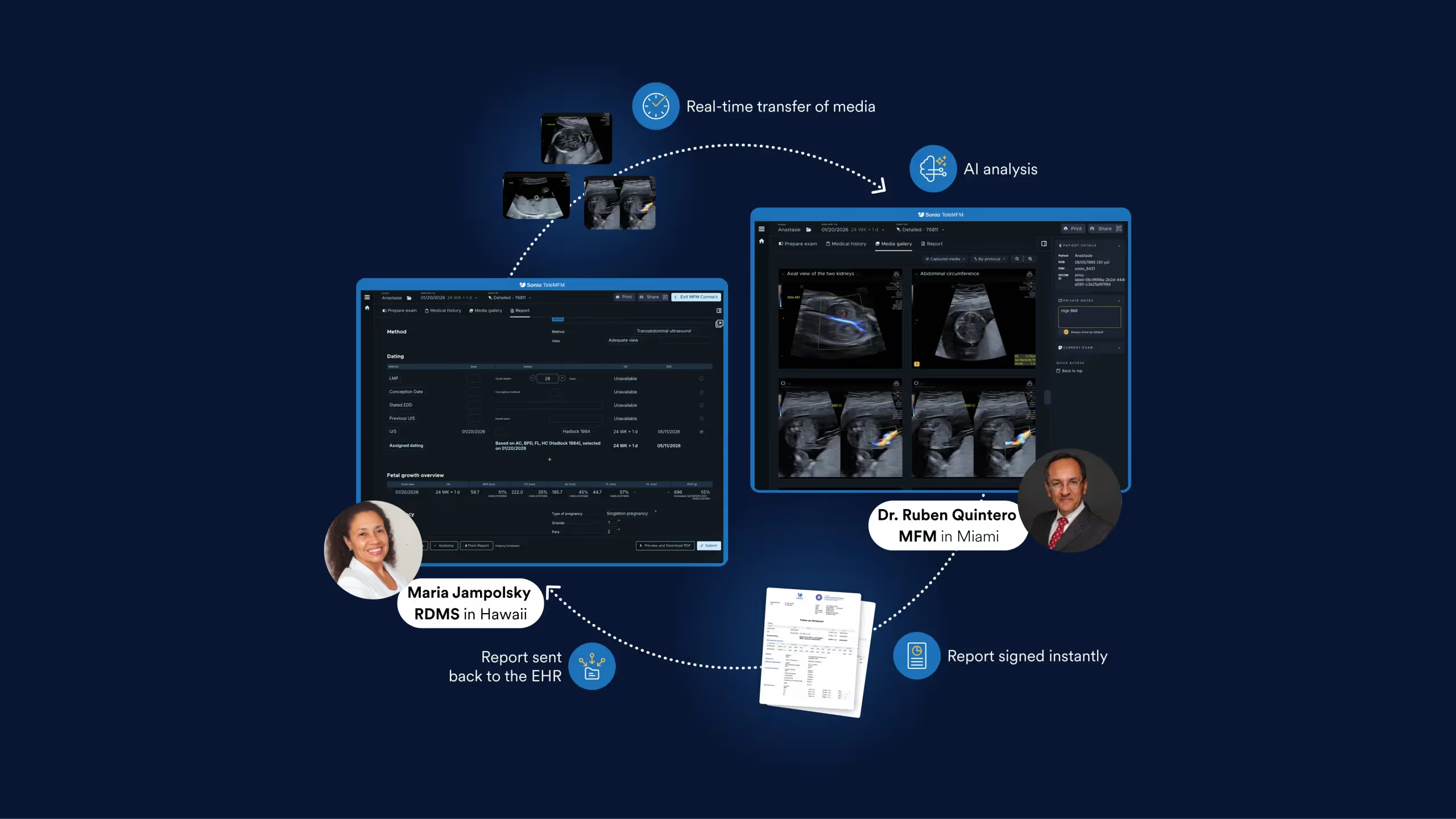
Sonio’s cloud-native architecture enables seamless telemedicine across sites, allowing for real-time coordination within the care team, regardless of location. It is built to support:
- Remote view and real‑time collaboration, connecting local obstetricians and sonographers with MFM expertise, on the mainland or anywhere in the world, without requiring patients to travel hundreds of miles
- AI-powered* quality assurance to help capture consistent, high-quality imaging
- Workflow streamlining designed to reduce reporting time and help teams manage high demand amid sonographer shortages
In Hawaii, where neighboring islands face limited MFM coverage and 72.9% of deliveries take place on O’ahu, tools like Sonio can reduce the need for travel and help prevent overwhelming surges of referrals to a single central location.
*AI capabilities are part of FDA 510(k) cleared Sonio Detect
What this looks like in practice at HI Frequency Imaging
For many of HI Frequency Imaging’s patients in Hawaii, a detailed fetal anatomy scan, like a NT or a detailed first trimester exam, or fetal echocardiogram can mean taking a day off work and flying to O‘ahu, because specialized imaging care is not available full‑time locally. For expectant parents, the stress of delayed access (waiting for specialists to travel to the neighbor islands) or the emotional and physical strain of traveling adds another layer of difficulty during pregnancy. For some patients, this travel burden can even increase risk, particularly when ultrasound surveillance is needed throughout pregnancy, including for those at risk of preterm labor.
By using cloud‑native collaboration and guided workflows, HI Frequency Imaging’s collaboration with Dr. Quintero at The Fetal Medicine Institute in Miami brings expertise to the patient instead of moving the patient to the expertise: exams are completed locally and then securely shared for remote review and final sign‑out. This practical remote‑reading workflow is a concrete example of TeleMFM supporting continuity of care across sites.
This approach has already made a meaningful impact for high‑risk patients. Local access to dedicated MFM ultrasound imaging has made it possible for patients to receive early screening such as NT and/or detailed first trimester exams and has allowed providers to monitor conditions such as oligohydramnios and perform biophysical profiles for high‑risk pregnancies, while continuing ultrasound surveillance for patients at risk of preterm labor who were unable to travel.
In several cases, patients experiencing significant access challenges due to extreme appointment backlogs were able to receive care in a clinically appropriate timeframe. Timely MFM evaluations of fetal anomalies have also enabled families to make critical management decisions without delay.
Patient feedback regarding access to dedicated MFM imaging has been overwhelmingly positive. In Hawaiian culture, many life milestones are experienced collectively with family, or ohana. Expanding remote and local imaging options on the neighbor islands reduces the burden of travel and allows expectant parents to receive care while remaining close by their support system, supporting both emotional reassurance and continuity of care.
Additionally, advanced 3D and 4D ultrasound imaging can serve as another valuable tool in this model. These technologies not only enhance maternal reassurance by providing clearer visualization of fetal development, but can also aid clinicians in diagnostic accuracy and care planning.
Life Saving Applications
AI is beginning to play a real role in standardizing and guiding clinical assessments, especially in settings where experience levels vary, staffing is stretched, and access to specialist review is limited.
In maternity care deserts, these capabilities can function as a digital safety net. They can help prompt earlier intervention in high-risk pregnancies particularly when the patient’s next available appointment or in-person specialty consult may be weeks away.
Just as importantly, AI-enabled platforms can make remote collaboration more effective: when images, findings, and reports are structured and complete, MFM specialists can review faster and guide next steps with greater confidence, even from hundreds or thousands of miles away.
Overcoming Barriers to High-Quality Care
Notable expansion of permanent telehealth laws and regulations has occurred across Hawaii. Drawing from the COVID-19 pandemic, telehealth laws in Hawaii demonstrate a strengthened system of remote monitoring practices, especially for pregnant people through prenatal support processes.
The Hawaii Perinatal Support Services program and The Hawaii Collaborative Health Initiative are among the organizations taking strides toward innovating the maternal-fetal healthcare space across the state, by increasing financial and human resources in rural areas on neighboring islands.
The impact of telehealth adoption in maternal care is already clear. In a University of Hawaiʻi report on expanding maternal telehealth, Men-Jean Lee, MD, Maternal-Fetal Medicine Fellowship Program Director at the University of Hawaiʻi at Mānoa John A. Burns School of Medicine, noted that “more than 50% of our patients were seen through telehealth visits, higher than any other subspecialty.”
This shift highlights telehealth’s growing role as a critical solution for improving access, continuity, and quality of maternal care across Hawaii, particularly for patients in rural and underserved communities where care models have faced ongoing geographic and workforce challenges.
“In Hawaiʻi, access to specialty care can be a challenge, many patients on the neighbor islands would otherwise need to travel to Honolulu to access the full range of perinatal imaging that is considered the standard of care. Using Sonio AI prenatal ultrasound platform in collaboration with Dr. Ruben Quintero has allowed us to build a remote-reading workflow that keeps patients closer to home. We provide perinatal screenings across all trimesters locally and collaborate in real time, so MFM review happens without long waits or the stress of travel. That continuity is critical, especially for patients who require ongoing surveillance. Sonio also supports consistency and efficiency, its QA tools reduce uncertainty and help ensure high-quality studies. It’s helped us deliver more timely, higher-quality care in regions with limited access to maternal-fetal medicine services.”

Maria Jampolsky
RDMS, Managing Director at HI Frequency Imaging