Congenital Malformations: Why Detection Is Still Difficult in Real-World Practice
Congenital anomalies are among the most consequential findings in prenatal care. Yet research shows that up to 51% of fetal anomalies* are missed during standard prenatal ultrasound screenings, with 31% of these missed cases resulting from misinterpretation of high-quality images**.
Real-world ultrasound practices operate under significant pressure: high exam volumes, varying equipment, different levels of experience, and constantly evolving protocols that are not always followed consistently. Structural anomalies of the heart, brain, and abdomen require complete anatomic coverage and careful interpretation, across every exam, every patient, every site. Addressing both dimensions, image quality and diagnostic consistency, is what creates the foundation for meaningful improvement.
How Sonio’s AI Pushes Ultrasound Capabilities Further
Sonio offers one of the first suites of FDA 510(k) cleared, machine-agnostic AI tools built specifically for prenatal ultrasound. Two distinct capabilities work together across the exam workflow.
- AI-powered*** ultrasound and clinical workflows
Sonio supports end-to-end ultrasound reporting by connecting acquisition, review, reporting, and billing handoffs in a single platform. Built-in clinical AI helps standardize exams and support quality control by leveraging image and annotation recognition to detect specific views and structures, then evaluating them against quality criteria to verify their presence. Practice analytics turn AI insights into actionable improvements in quality assurance and operational efficiency. The result: standardized, consistent exams regardless of site or ultrasound experience.
- AI-driven**** abnormality detection in critical fetal anatomical regions: heart, brain, and abdomen**
Sonio Suspect enables early identification of subtle congenital malformations from as early as 11 weeks. By providing a broader diagnostic window, it supports clinicians in identifying abnormalities sooner, giving families and healthcare providers more time to act, plan interventions, and improve both maternal and fetal outcomes. Sonio Suspect provides automatic detection of eight abnormal findings across seven ultrasound views of three key fetal anatomical regions:
- Heart (Absence or unusual size of at least one of the 3 vessels, Disequilibrium OR absence of at least one of the two ventricles, Malposition of the great vessels, Thoracic situs inversus),
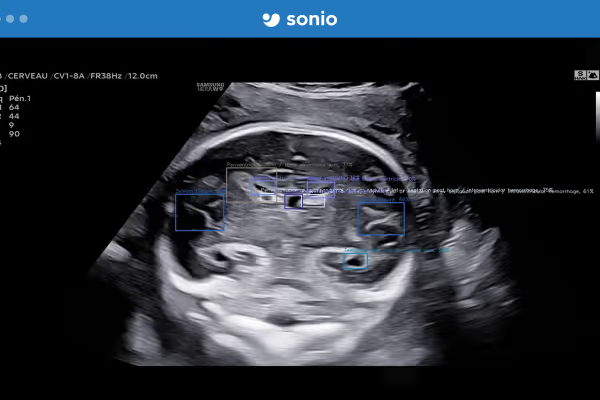
- Brain (Absence of the cavum septum pellucidum on the axial view, Complete agenesis of the corpus callosum on the sagittal view),
- Abdomen (Abdominal situs inversus, Absence of the stomach OR presence of two stomachs)
In a multicenter reader study across 47 sites, including 37 in the United States, Sonio Suspect demonstrated a statistically significant 22-point improvement in anomaly detection (from 69% to 91% AUC, p<0.001), consistent across patient demographics, BMI, and clinician background. These results were further validated in a publication in Obstetrics & Gynecology (Morisset et al., 2026), spanning 942 patients across 75 sites in 5 countries.
Looking Ahead: Sonio’s Active Research in Brain AI
Sonio’s current research focuses on expanding AI’s ability to detect subtle ultrasound findings in clinically important areas where the evidence base is still developing. Initial studies target high-prevalence conditions such as congenital CMV, which affects an estimated 20,000 to 30,000 newborns in the US each year*****.
- Fetal brain anomaly detection: Sonio’s AI is trained on both normal and pathological brain images across axial, sagittal, parasagittal, and coronal views, to support identification of a broader range of structural findings
- Congenital CMV screening: Sonio is developing AI-assisted detection of ultrasound signs associated with congenital cytomegalovirus infection, including subependymal cysts, intracranial calcifications, interventricular septation, and ventriculomegaly.
With promising results, Sonio continues to evaluate these capabilities with leading fetal medicine centers, with the goal of building AI that is rigorously validated and engineered for routine clinical use supporting improved outcomes for mothers and babies.
Continue the conversation at The III Fundamentals and Updates in Fetal Medicine Conference
The III Fundamentals and Updates in Fetal Medicine Conference, co-organized by Northwell Health and the Fetal Medicine Foundation USA, will bring together MFM physicians, sonographers, and clinical leaders working at the frontier of prenatal diagnosis.
Sonio is excited to be a Platinum sponsor at this year’s conference. Our clinical team will be in attendance. We are eager to connect with clinicians who are thinking carefully about where AI fits in fetal medicine and are passionate about advancing its use in clinical settings to support quality care delivery.